Writing · · 6 min read
A Fake Job Interview. Then a $6.36 Billion Heist.
The biggest crypto heist on record took about twenty minutes, and Binance says the way in was a job that never existed. The long version, on the clock.
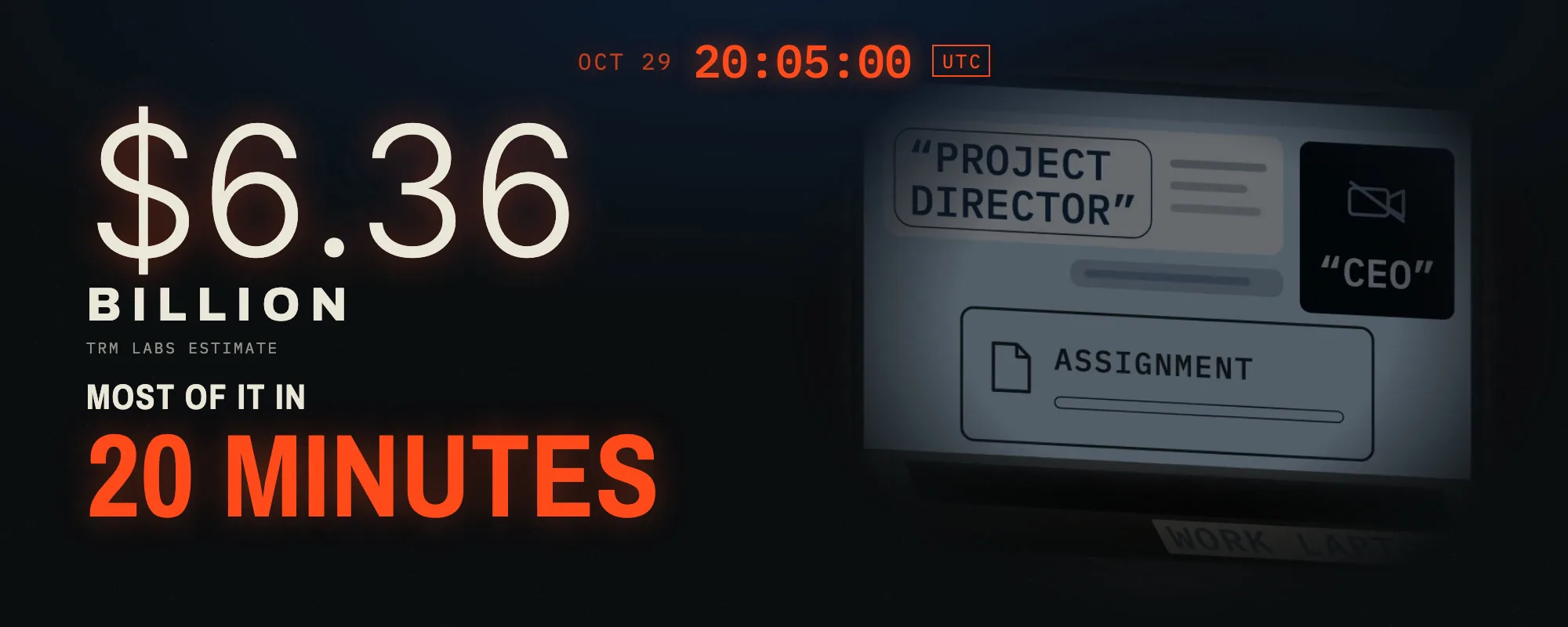
$6.36 billion. Most of it gone from Binance in about twenty minutes.
That is TRM Labs' estimate of what left the exchange on the night of Thursday, October 29, 2026. The biggest crypto heist on record.
And the way in, Binance says, was a fake job interview.
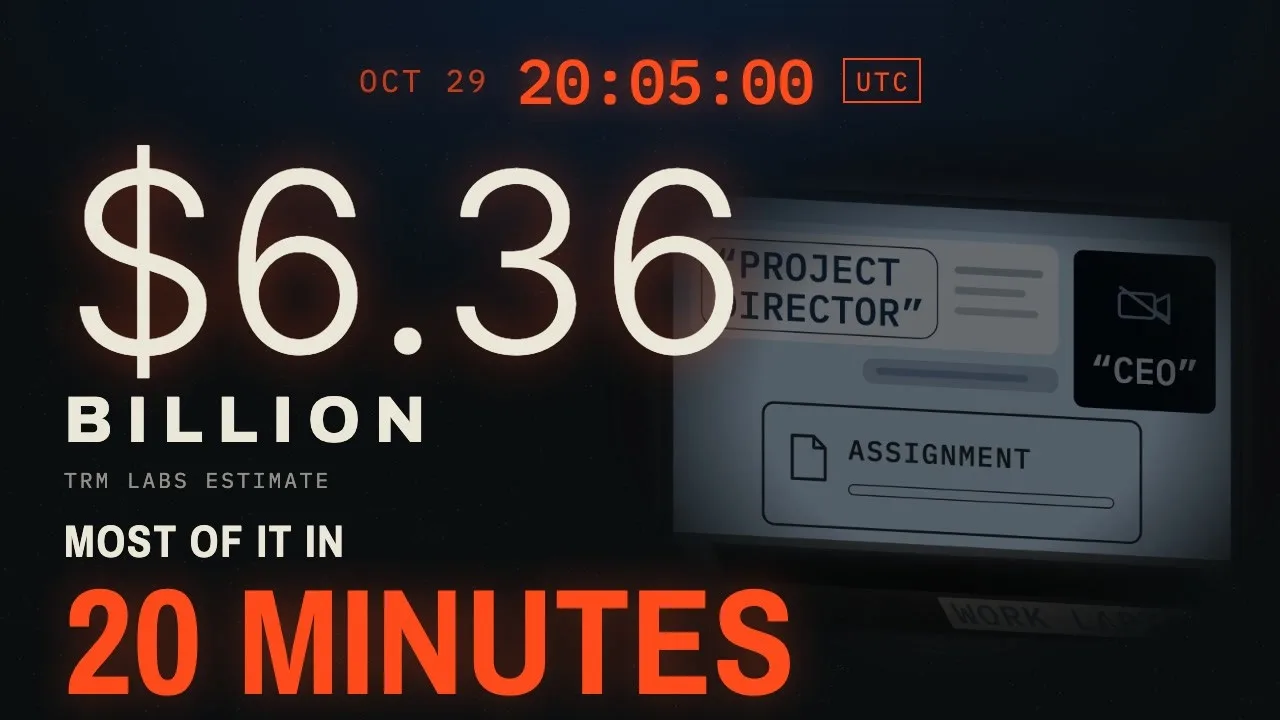 Watch on YouTube · Tin Can PlanetTwenty MinutesThe video this piece grew out of
Twenty Minutes, an animated short from Tin Can Planet, tells that night on the clock. This is the long version: the times, the figures, and the questions Binance hasn't answered yet.
September: the bait
A Binance engineer gets a message on a job-hunting site. It's from someone presenting as a "project director."
The first interview, with a fake HR representative, is there to build trust. Social media accounts. Personal photos. Videos. A whole life online.
None of it real.
The second interview is with a fake "CEO" on a chat app, and it comes with one request: an assignment. The engineer downloads it on his work laptop. It carries malicious code.
That is Binance's own account, from the initial incident report it published on November 3. The company called the approach "more advanced and deceptive than previously seen social engineering approaches." It also said this:
"This should not have happened."
Binance hasn't named the engineer, and neither do we.
June to October: months of patience
September wasn't the first attempt. Binance's report traces the campaign back to June. By NPR's account, Binance detected and stopped an attempt that month, but the attempt let the attackers learn more about Binance and its systems; SecurityWeek describes a tampered developer tool. In October, SecurityWeek reports, an internal AI tool was abused as well.
By October, Binance says, the attackers had reached its internal wallet signing service: the system that signs the exchange's transactions.
October 28-29: the rehearsal
TRM Labs traced the preparation on the blockchain. On the morning of October 28, at least 36 hours before the theft, three small withdrawals from the crypto mixer Tornado Cash funded the attackers' operating wallet. On October 29, their code was tested on one wallet, then a second, then rehearsed in full on a third. About four hours later, it was installed on a Binance hot wallet.
Then came the part the film calls the permission slips.
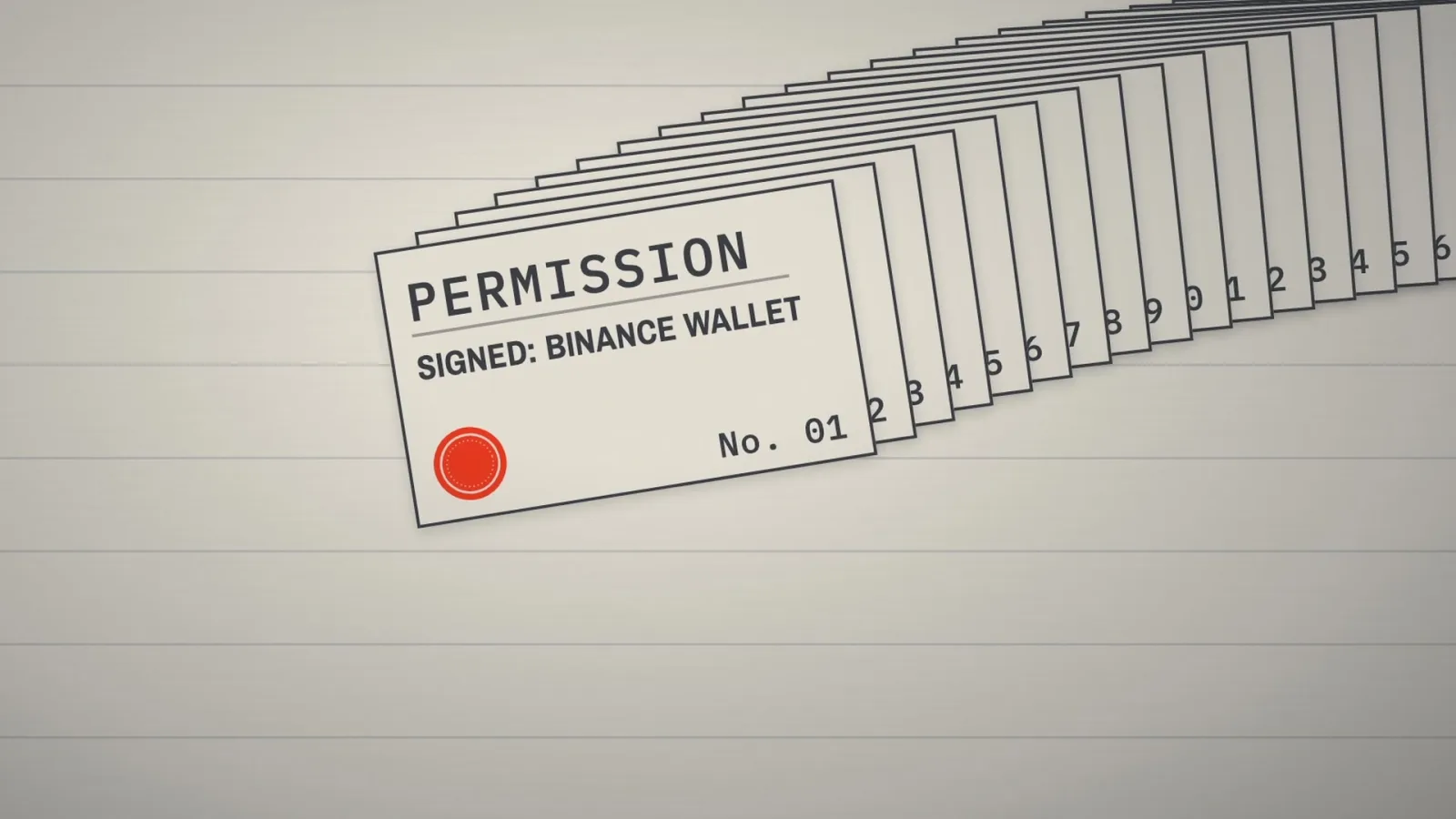
They weren't keys. Binance said it found no evidence of a private key leak. What the attackers had was 50 pre-signed authorizations (the technical name is EIP-7702), each signed by Binance's own Ethereum hot wallet, each telling that wallet to take orders from the attackers' code.
Each authorization works only at one exact transaction number, and that number moves up by one with every transaction the wallet makes. So they brought fifty, numbered in a row.
Only one had to match.
One did.
The catch
Much of what sat in those wallets was stablecoins: digital dollars. By our sum of TRM's October 30 per-chain figures, about $3.4 billion of the $6.36 billion, roughly 53 percent, was Tether's USDT, Circle's USDC and Ripple's RLUSD.
The companies that issue stablecoins can freeze them.
So when the attackers moved, they had to be fast.
20:05 UTC: the vaults open
All times are UTC, which that night was also London time: 8:05 pm in London, 4:05 pm in New York. From TRM Labs' timeline:
- 20:05 The XRP wallets start to drain. By 20:09 they are empty: about $296 million.
- Shortly after 20:10 Solana and Optimism.
- 20:20 18,270 bitcoin, about $1.47 billion. In the same minute, the transaction carrying the fifty authorizations goes in.
- Within two minutes Tron: about $628 million.
- About 20:23 The main Ethereum hot wallet's whole balance: 167,464 ether and 63 tokens, including 1.615 billion USDT.
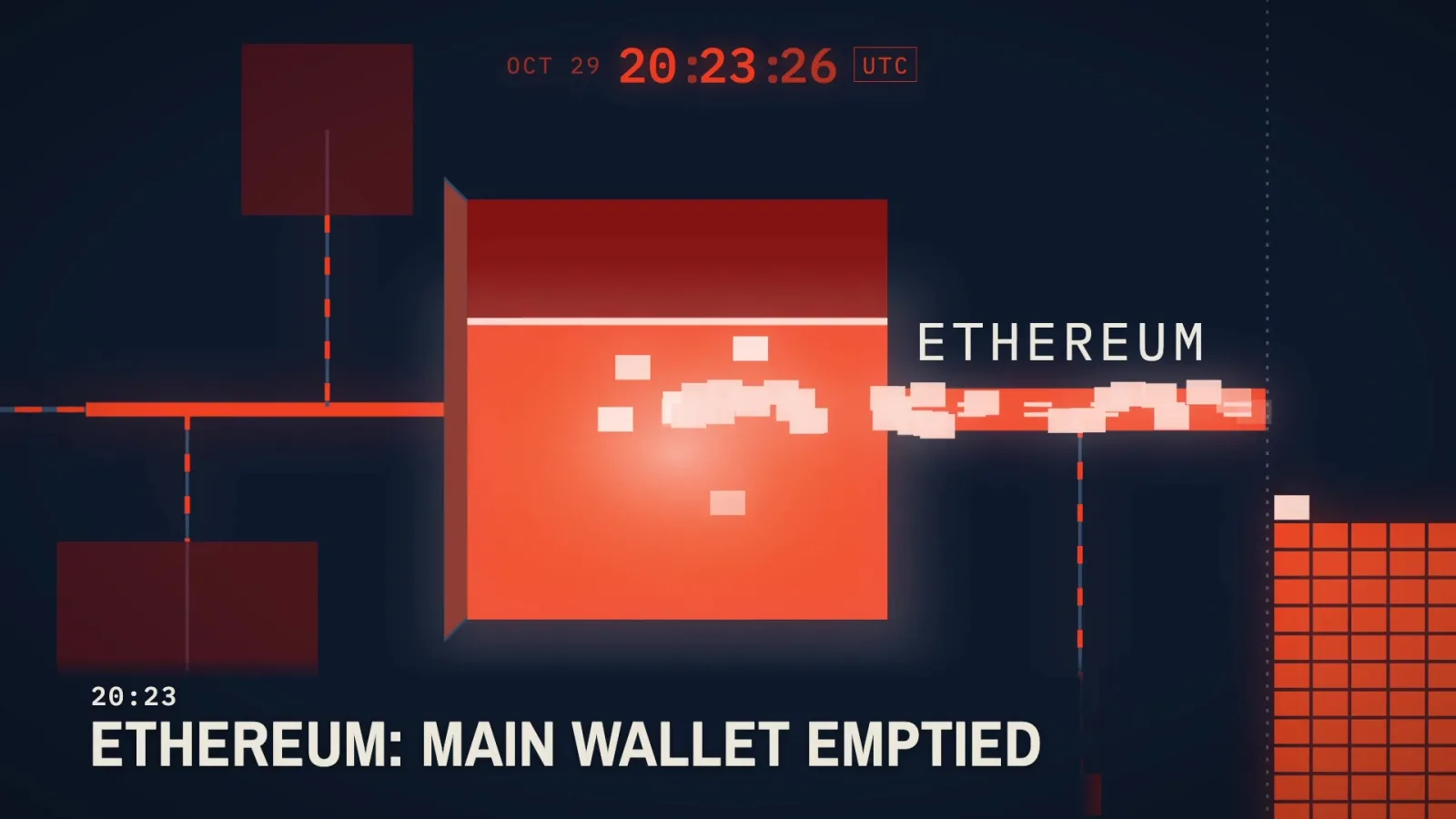
That is "about twenty minutes" for most of the money. It wasn't the end. Follow-up sweeps on Ethereum ran until 23:56, and Avalanche and Polygon were hit around 23:05. Ten blockchains in all.
21:01: the freezers wake up
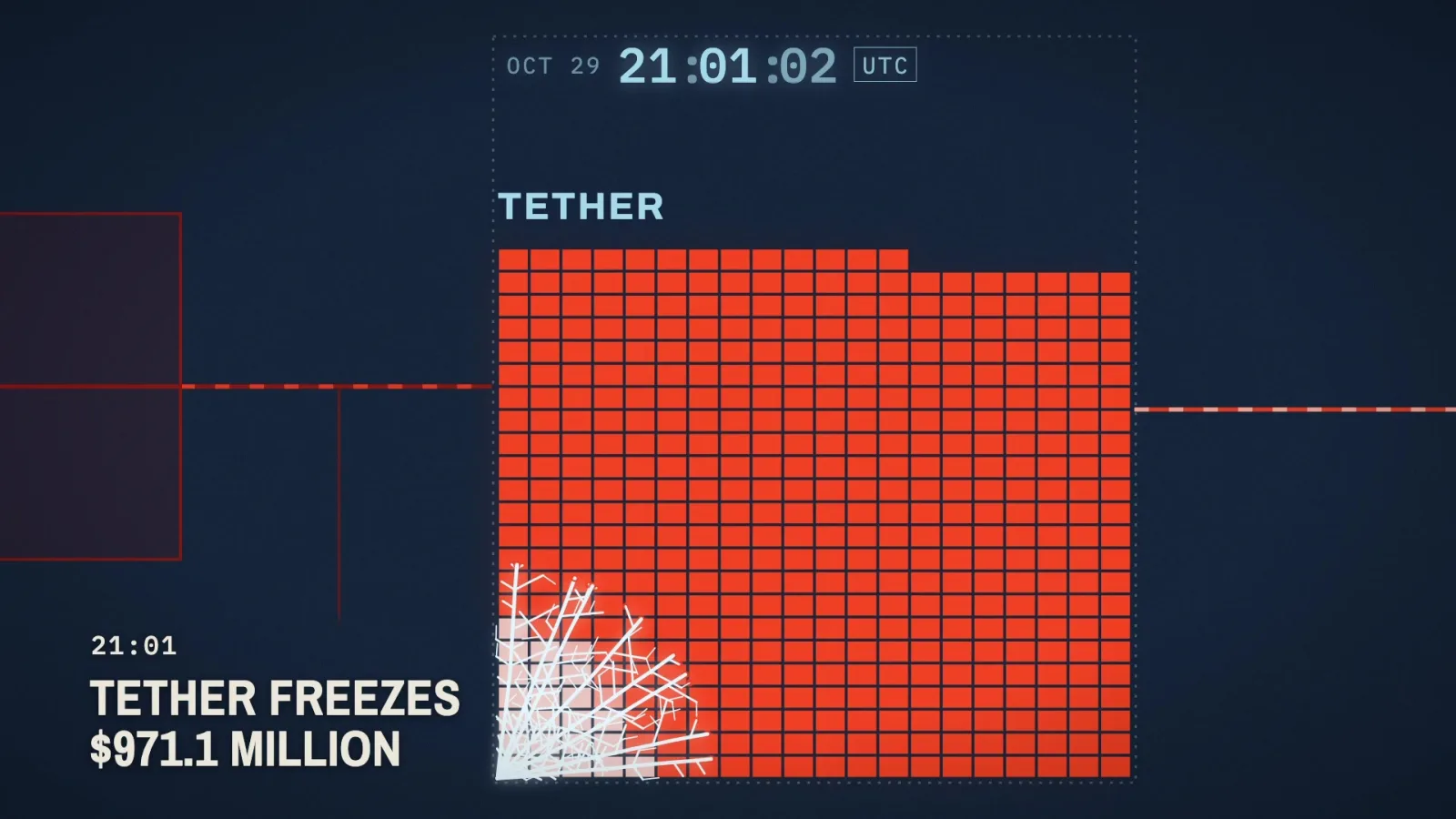
At 21:01, Tether froze 971.1 million USDT. That was 37 minutes after the Ethereum sweep, and 56 minutes after the first wallet moved. By TRM's October 30 count, Tether's freezes totalled about 1.77 billion USDT.
At 21:04, Circle froze $823 million in USDC. Ripple froze RLUSD at 22:01. At 00:08 on October 30, Arbitrum's Security Council froze 8,426 ether and 74.6 million ARB. Aave froze the affected markets.
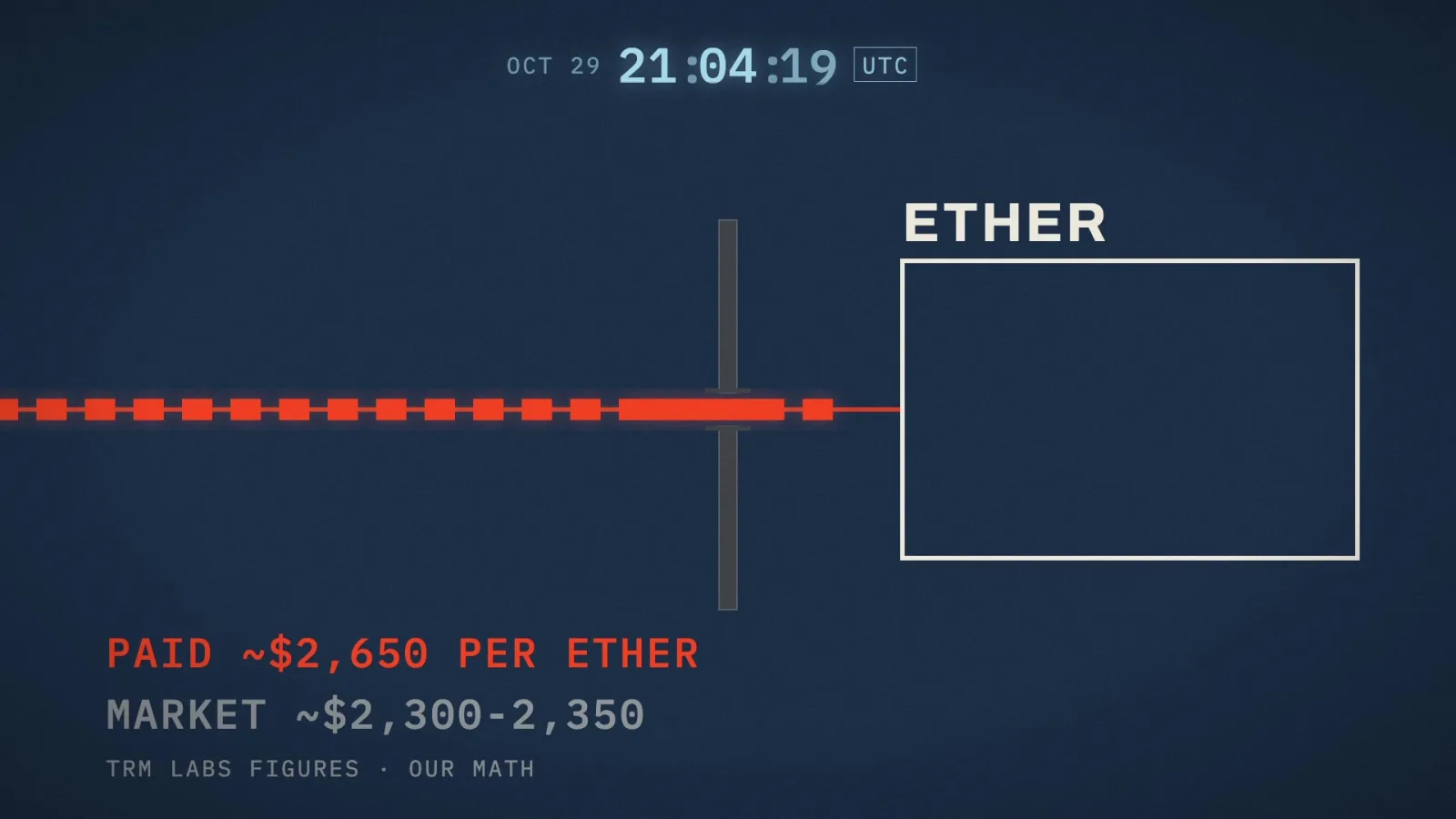
As the freezes spread, the attackers raced to swap into ether: a coin no company issues, and no company can freeze. TRM's figures show about 325 million USDT swapped into about 122,300 ether. That's around $2,650 per ether, while ether traded at about $2,300 to $2,350.
By our math, they paid more than ten percent over the market price, just to get out of dollars fast.
00:10: the door closes
Binance says its hot wallet was built on multi-party computation, so that no single key could move it.
Which also meant no single key could quickly stop it.
Binance says it had no single key to cancel the attackers' delegation. The door wasn't shut until 00:10 UTC on October 30, about four hours after the first wallet moved.
The count
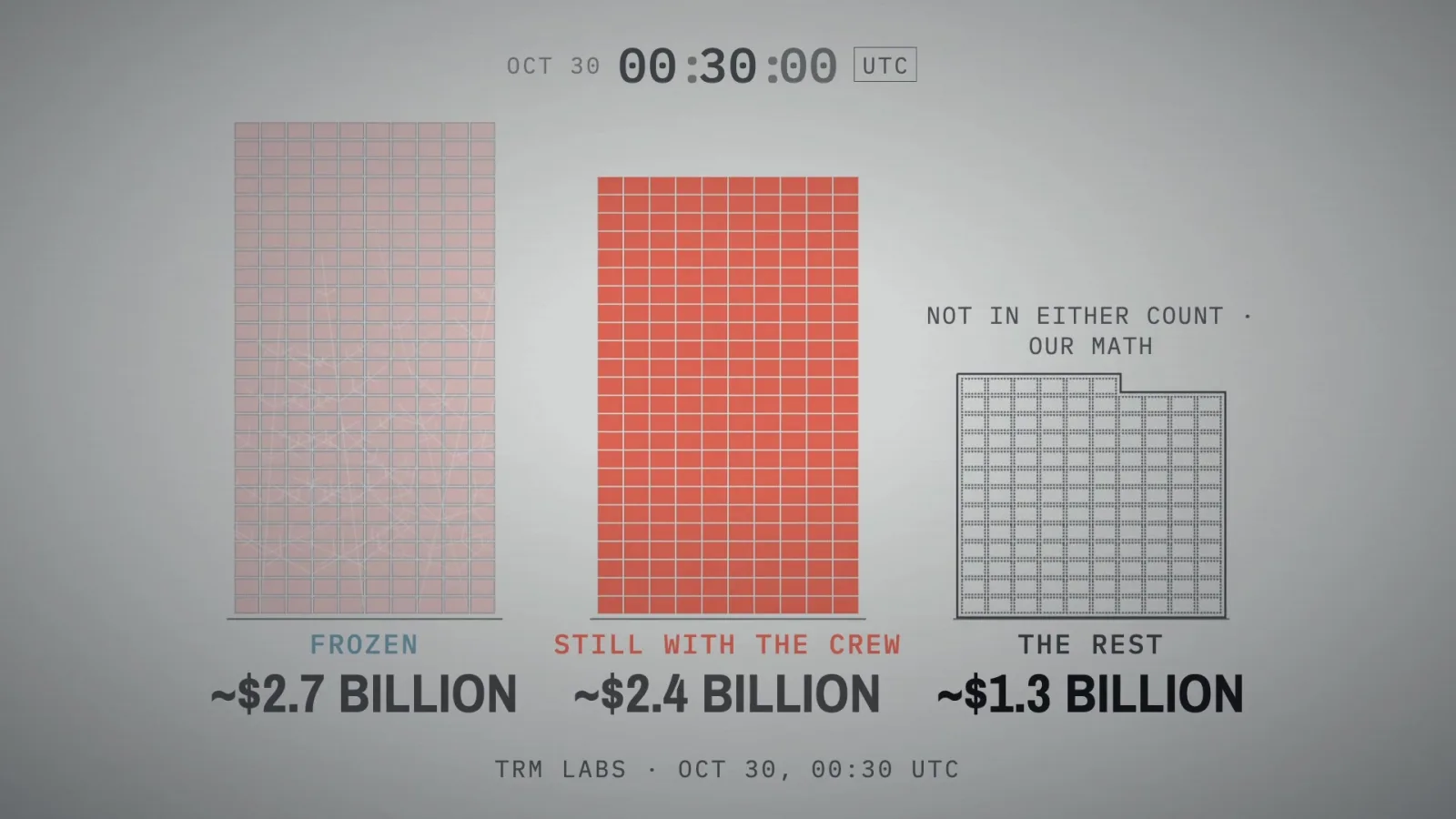
At 00:30 UTC on October 30, TRM Labs counted about $2.7 billion frozen and about $2.4 billion still with the attackers. Those two figures don't add up to the total. By our arithmetic, about $1.3 billion was in neither count that night.
The numbers kept moving. Binance's November 3 report put the amount frozen or intercepted at about $2.85 billion. By November 12, Fox Business reported, federal authorities and private-sector partners had frozen more than $2.7 billion.
Even the total depends on who is counting, and when. $6.36 billion at transfer-time prices is TRM's figure (October 30). Binance's is about $6.34 billion (November 3). Chainalysis (October 30) says about $6.4 billion.
Binance says it covered the whole loss with its own money. On November 12, it said it had completed coverage of more than $6.34 billion from company funds.
Who did it
The FBI says North Korea did it. In an alert on October 31, it named the hackers it calls TraderTraitor. TRM Labs and Chainalysis had linked the theft to North Korea the day before.
North Korea denies it. Kim Yo Jong, the North Korean leader's sister, called the FBI's attribution "a trite provocation" and "an absurd rhetoric," AP reported.
The record before this one
The previous record was another exchange, Bybit: about $1.5 billion, on February 21, 2025. Five days later, the FBI attributed that one to TraderTraitor too.
Same crew, says the FBI.
What we still don't know
Binance calls its November 3 report initial, and an independent cybersecurity review is planned. Binance hasn't said whether the attackers had access the whole way from June to October, or how its signing service came to approve their transactions. SecurityWeek notes the report doesn't explain how the AI tool was used.
What is on the record is the shape of it.
Months of patience.
Twenty minutes of theft.
And the way in was a job that never existed.
Sources
- TRM Labs, "North Korea Steals USD 6.36 Billion From Binance in the Largest Hack in History" (Oct 30, 2026)
- Binance, "29 October Binance Security Incident: Initial Findings and Response Update" (Nov 3, 2026)
- NPR, the engineer and the fake interview (Nov 3, 2026)
- The same NPR story, member-station copy (WUNC)
- SecurityWeek (Nov 4, 2026)
- FBI alert (Oct 31, 2026)
- FBI public service announcement on Bybit (Feb 26, 2025)
- Chainalysis (Oct 30, 2026)
- AP, North Korea's denial (Nov 2, 2026)
- Fox Business, the frozen total (Nov 12, 2026)
- Bitcoin Magazine, Binance covers the losses (Nov 12, 2026)
Twenty Minutes is an animated short from Tin Can Planet. Numbers as reported at the time; checked November 13, 2026.