Writing · · 8 min read
Nvidia's CEO Is Out. The Spy Story Isn't the Scary Part.
Nvidia's CEO resigned with no reason given. The spy story grabs the headlines, but the scarier part is who was supposed to be watching him.
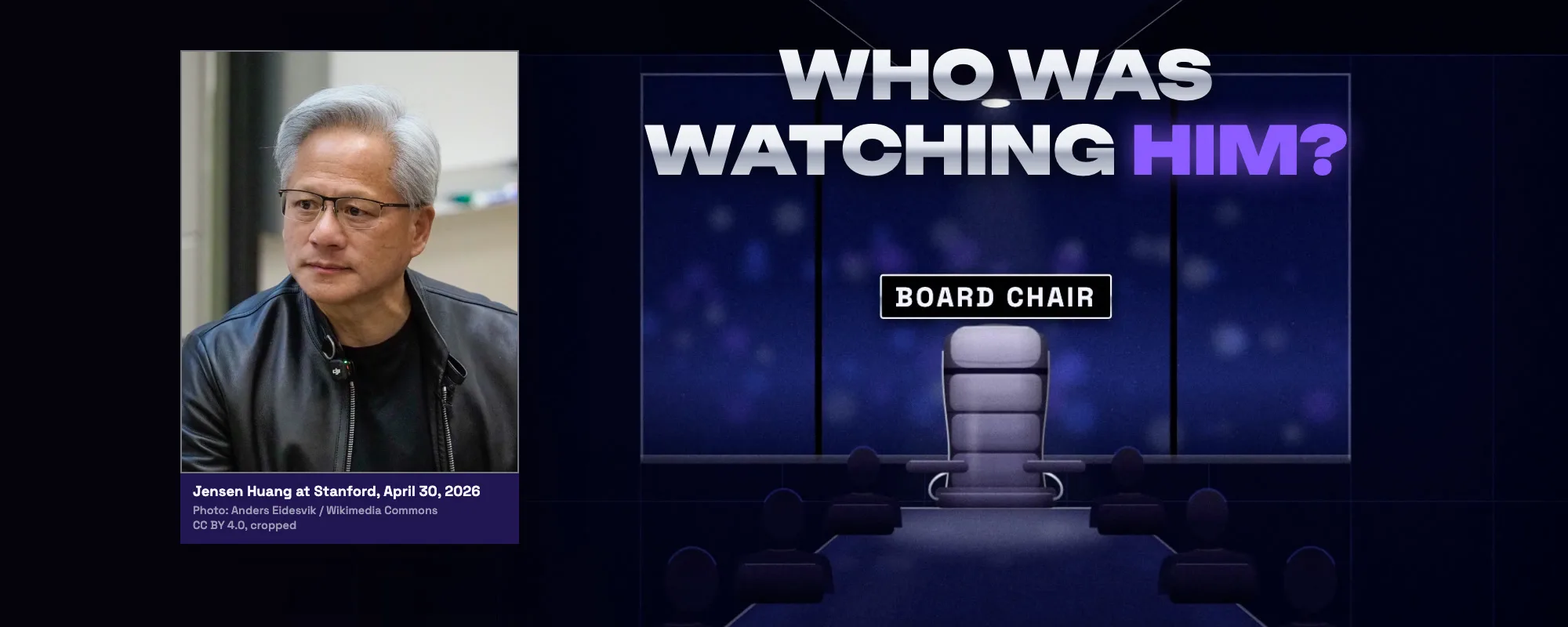
Nvidia's CEO, Jensen Huang, is out, and the filing gives no reason.
The board "accepted the resignation" of Huang as president, chief executive and director, effective immediately. That's Nvidia's 8-K, filed with the SEC on Thursday, November 12, 2026. It doesn't say why.
Four days earlier, Nvidia told CNBC: "Jensen is committed to continuing to lead NVIDIA as CEO without interruption."
 Watch on YouTube · Tin Can PlanetThe Empty ChairThe video this piece grew out of
The Empty Chair is a sourced hot take from Tin Can Planet. Here's the long version, with every denial.
November 8 to 12: four days
On Sunday, November 8, Nvidia's board opened an independent investigation into reports that Huang had been "the target of a foreign intelligence effort."
The board said it had "no reason to believe that either national security or NVIDIA secrets were compromised." It also said: "The Board has confidence in Jensen and his leadership team."
The same day, in an email to staff, Huang admitted an affair. "I support the investigation and will cooperate fully," he wrote.
On Wednesday, November 11, the board accepted his resignation. Nvidia announced it the next day.
The filing gives no reason. Here are the dates, side by side.
November 8: "without interruption." November 12: "effective immediately."
November 10: seven billion dollars, unverified
Then a report from The Information said his ties to a businesswoman helped more than $7 billion of Nvidia chips reach China. Its headline says "$7 Billion-Plus"; Reuters' summary says "at least $7.5 billion," for a whole alleged network of buyers since 2023. It's an anonymously sourced estimate, not an audited sum.
Reuters "could not independently verify" the report, and the companies named in it didn't respond to Reuters. Nvidia told The Information it applies the same standards to every deal and expects its partners to follow U.S. export rules.
Nvidia makes the chips the AI boom runs on. Its best ones are barred from China.
The obvious question
Was it a honey pot?
Wrong question.

The right one is: who was supposed to be watching the man? The answer starts with a chair that sat empty for thirty-three years.
First, though, the theory, fast, with all four denials.
The honey-pot theory, and four denials
A honey pot: get close to someone powerful, personally.
Reuters, citing two people who know her, says the affair was with that businesswoman. The New York Times reports a government memo says she was "recruited by China's Ministry of State Security." Singapore has barred her from re-entering, saying she misled its investigators in a probe of an Nvidia customer she once ran.
The answers, on the record:
- Nvidia's board (Nov 8): "no reason to believe" national security or Nvidia secrets were compromised.
- China's Foreign Ministry (Nov 9, via AP): "It is nothing but smears against China."
- Singapore's Ministry of Home Affairs (Nov 12): she "was not investigated for espionage."
- U.S. Attorney General Todd Blanche (Nov 12): "There's no conclusions reached... about who she is or is not."
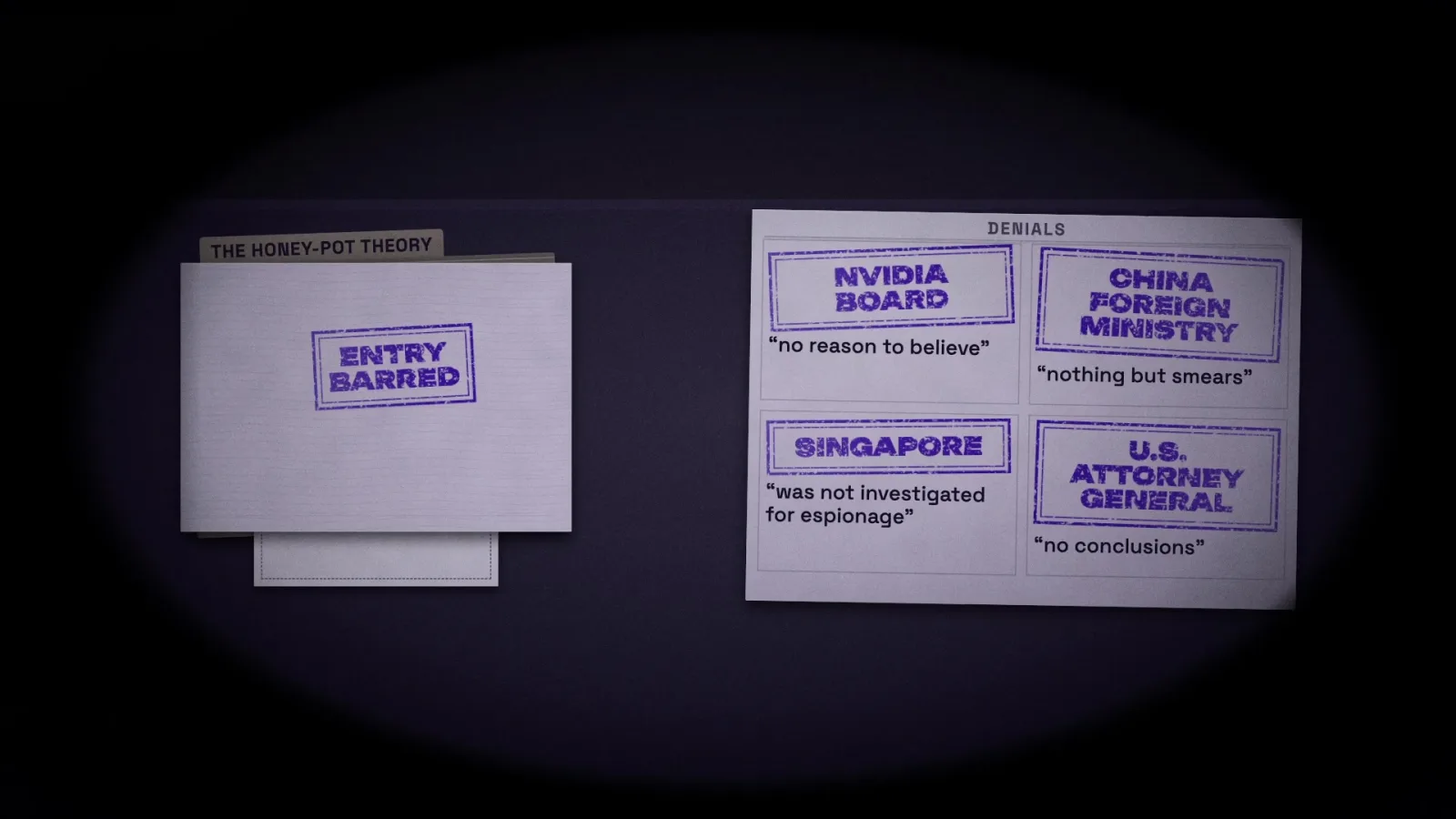
None of it is proven, she hasn't been charged, and nobody has shown a honey pot.
The story doesn't need one.
Late summer 2025: a call to Commerce
Here's the strangest part.
Bloomberg reports that in late summer 2025, after Singapore detained her, Nvidia's top in-house lawyer called a senior Commerce Department official. His question: were Commerce's own export enforcers involved in her detention? Bloomberg's sources say they weren't.
Nvidia says the lawyer "was unaware of the affair" when he called, and that it consults officials "to answer their questions, provide information we have gathered from the field, request their guidance and instructions."
Take Nvidia at its word. Then, if Bloomberg is right, Nvidia's top in-house lawyer was asking Washington about her detention without knowing about the affair.
Why she mattered
Why would she matter to Nvidia? She'd once run one of its customers.
And, in Reuters' words, The Information reports she "leveraged her relationship with Jensen Huang to build credibility."
So the company was asking questions about her.
Was anyone asking questions about him?
The first watcher: the board
A board chair runs the board a CEO answers to. For thirty-three years, Nvidia didn't have one. (Nvidia was founded in 1993; the thirty-three is our arithmetic.) Huang never held the title either.
Instead, its 2026 proxy statement described "an independent Lead Director, rather than a chairperson," and said its independent directors' involvement and the lead director's "strong oversight" would "provide balance on the Board." And:
"We believe that our current structure best serves our stockholders, without the need to appoint a person to serve as chairperson of the Board."
The lead director in that proxy, Stephen Neal, used to chair Cooley, the outside law firm that set Nvidia up in 1993. He was still Cooley's chairman when he joined Nvidia's board in 2019. Nvidia's 2026 annual report lists Cooley as its general legal counsel. The board counts him as independent.
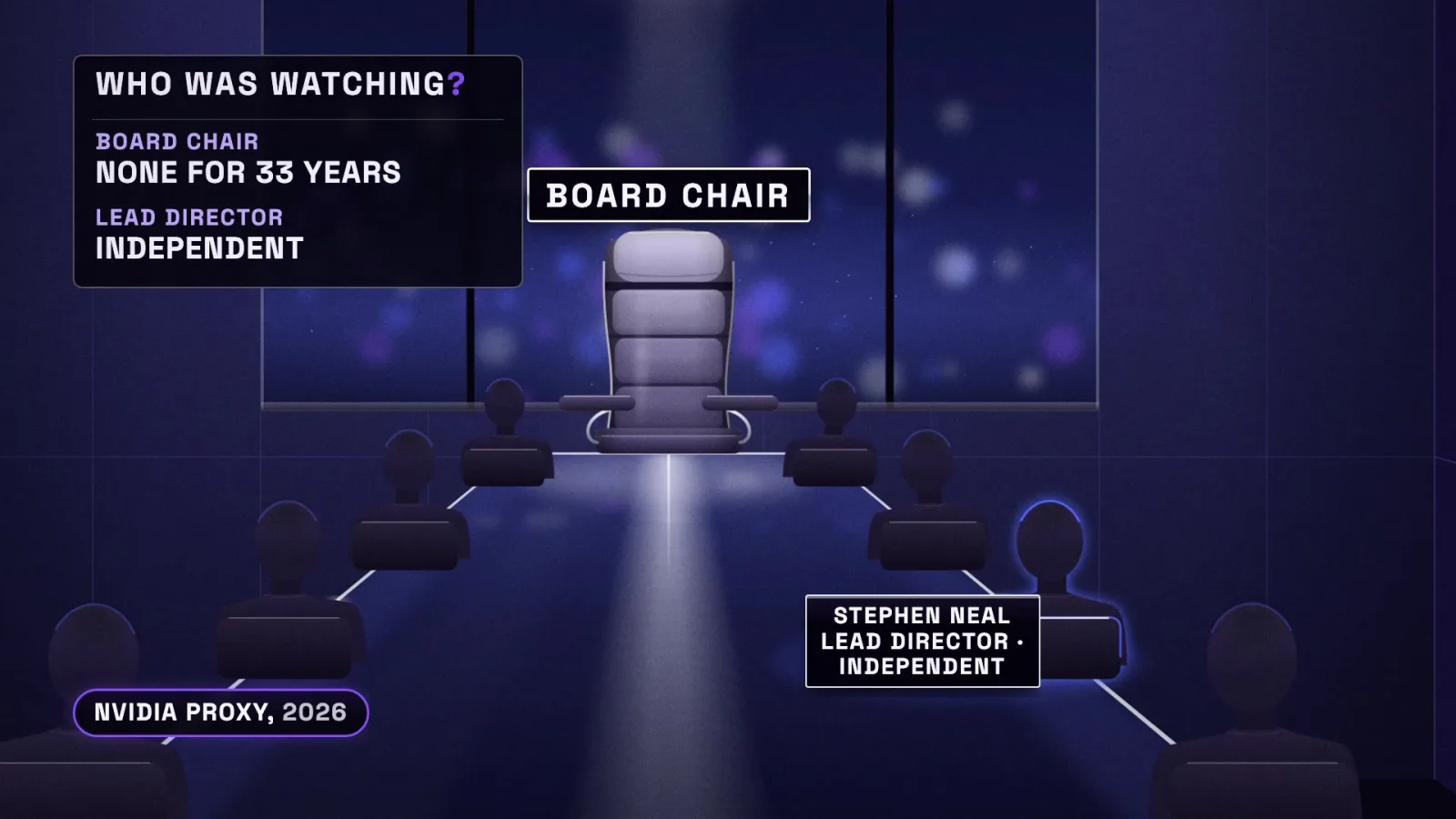
Two of the directors have been there since 1993. Semafor (Nov 9) puts the board's average at "almost 15 years — nearly twice as long as the average S&P 500 director."
By his own count, on Lex Fridman's podcast, about sixty people reported straight to Huang, with no one-on-ones, because "it's impossible." Semafor notes there was no clear number two: no separate president or chief operating officer.
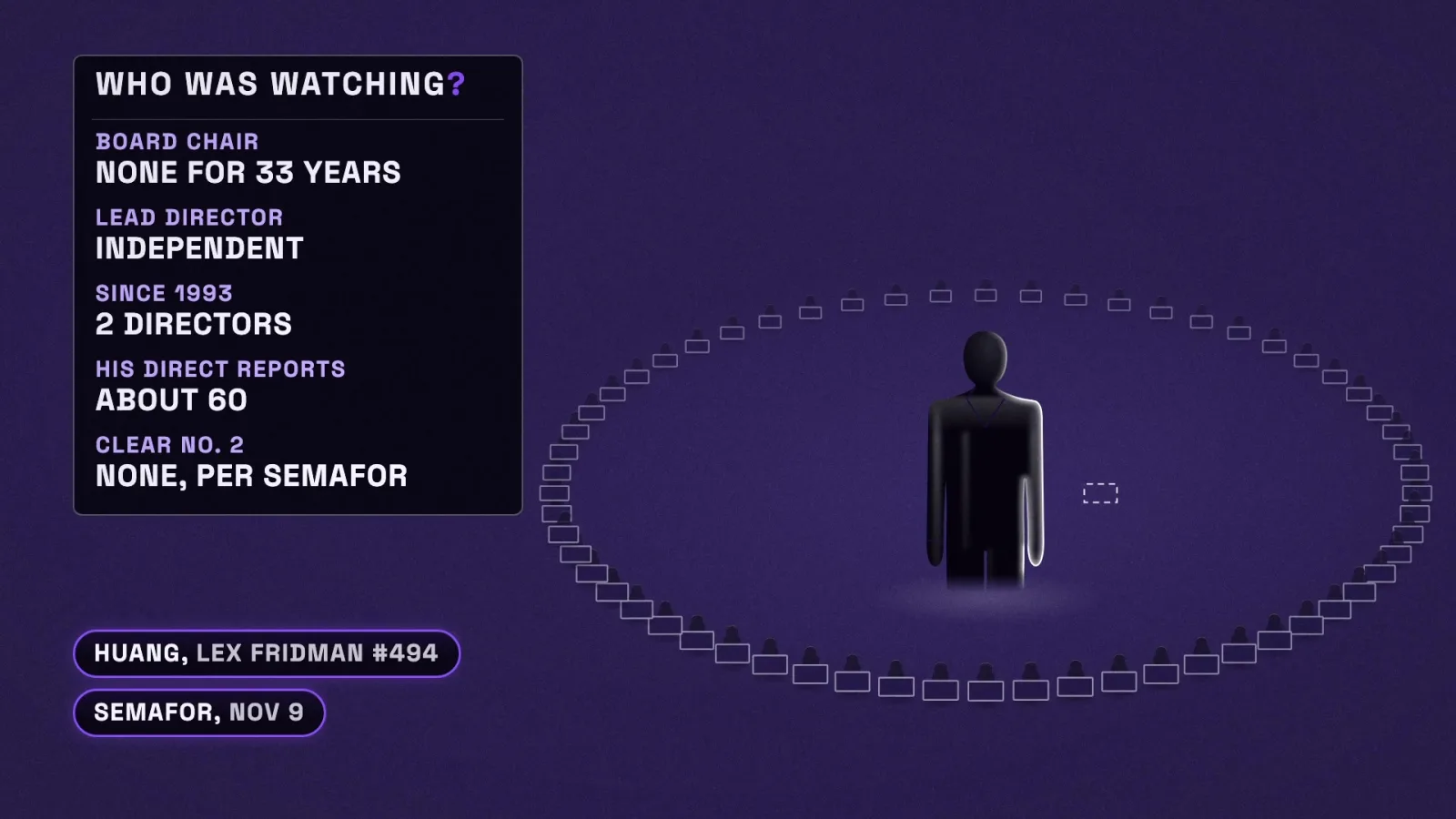
And he's said it himself, on the same podcast: "I'm famous in saying that I don't believe in succession planning." His alternative is to pass on knowledge "as often and continuously as you can."
The sceptic, answered
Now, plenty of founders run their own boards. Few of them make the chips America bars from China.
And this one didn't control the vote. Per the 2026 proxy, Huang owned about 3.6 percent of Nvidia, with one vote per share; BlackRock and Vanguard each held about twice as much.
Yale's Jeffrey Sonnenfeld, on CNBC on November 12: "Somebody needs to ask some questions, and that's what's missing here."
And the Sunday the investigation opened, the board's answer was "confidence in Jensen."
Someone inside did ask: the guarantees
The Wall Street Journal reports (Nov 13) that CFO Colette Kress questioned guarantees "worth billions of dollars" that Nvidia discussed for data center operators that couldn't afford to buy its chips up front. By the Journal's account, she asked how to choose the deals, value the guarantees and calculate the returns.
And, citing one source, the Journal says that in the summer, Huang interrupted her presentation to call her "a deer in the headlights." We found no response from Nvidia or Huang to the report.
Remember her.
The other watcher: Washington
The New York Times has reported, and repeated on November 10, that the President was briefed about the businesswoman in late 2025 and "chose to take no action." The White House disputed the reporting on background, without detail.
Asked on November 9 whether he'd been briefed on it in 2025, Trump said he'd "certainly check with the intelligence people."
December 2025: the cut
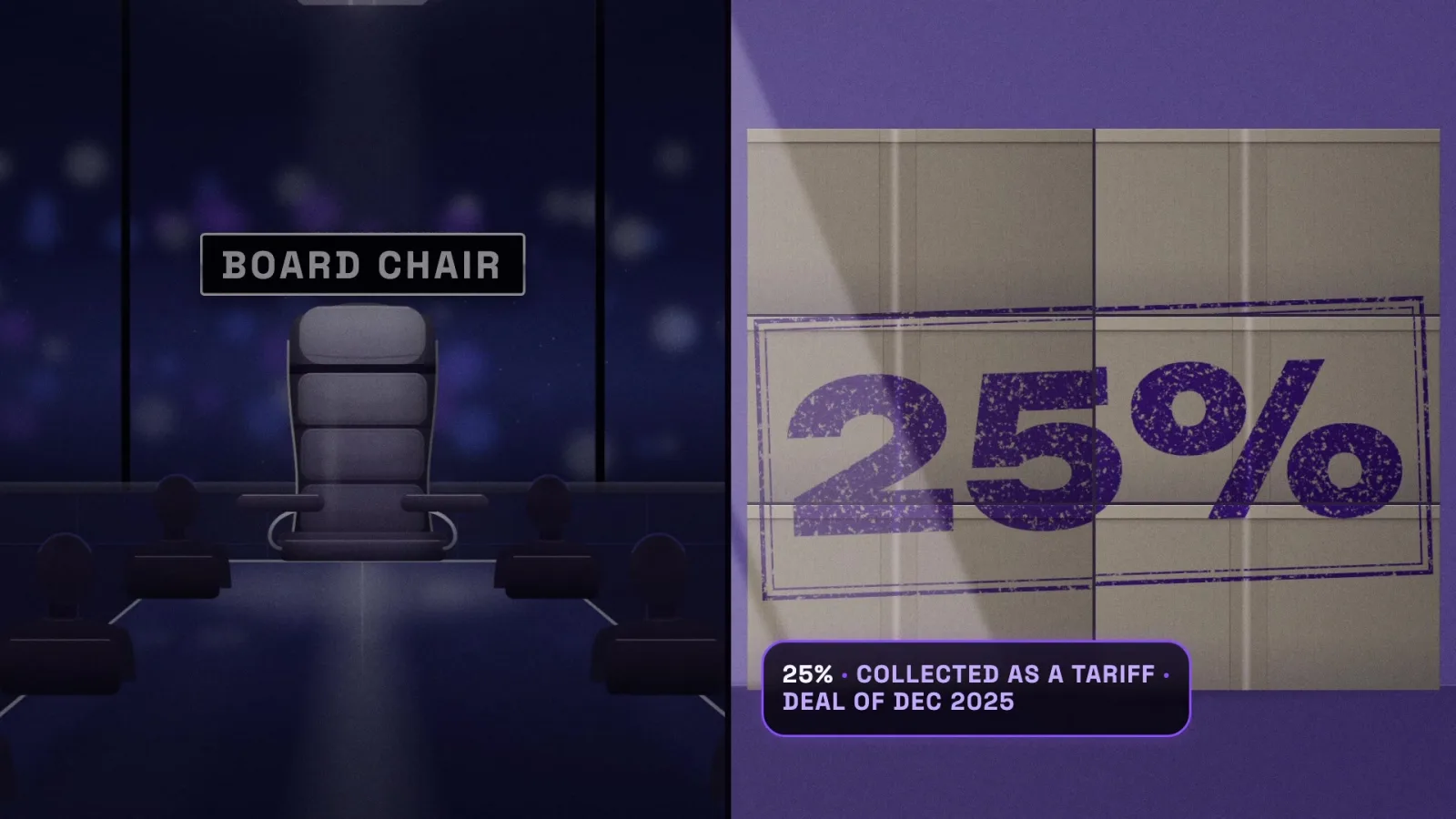
Separately: under a deal Trump announced on December 8, 2025, Nvidia may sell its older H200 chips to approved customers in China. Since a January 2026 tariff order, Washington takes a 25 percent cut, collected as a tariff: the chips come into the U.S. for third-party testing, pay the tariff, then get licensed for export case by case. The top tier, Blackwell and Rubin, was left out of the deal.
The take
So here's my take.
If The Information's reporting holds, the easiest way to the most-wanted chips on earth was never the firewall.
It was access to the man.
And his two watchers? The board watching him had an empty chair at its head. The other watcher had written itself a cut of Nvidia's approved China sales.
Where it stands
As of November 13, nobody in this story has been charged, and the board's investigation is ongoing.
And the CFO who asked those questions?
She's running Nvidia now.
Colette Kress is interim CEO, and still CFO, while the board looks for a permanent one. On November 13 the board told CNBC it was "in the process of selecting a search firm." Her first quarterly results as interim CEO are due on November 17.
What's still open
Nvidia hasn't given a reason for the resignation. The board's findings aren't out. And Nvidia hasn't said whether the lead director role continues now that it has a chair.
The empty chair
Honey pot or not, you don't need a spy to have a security problem.
You need an empty chair.
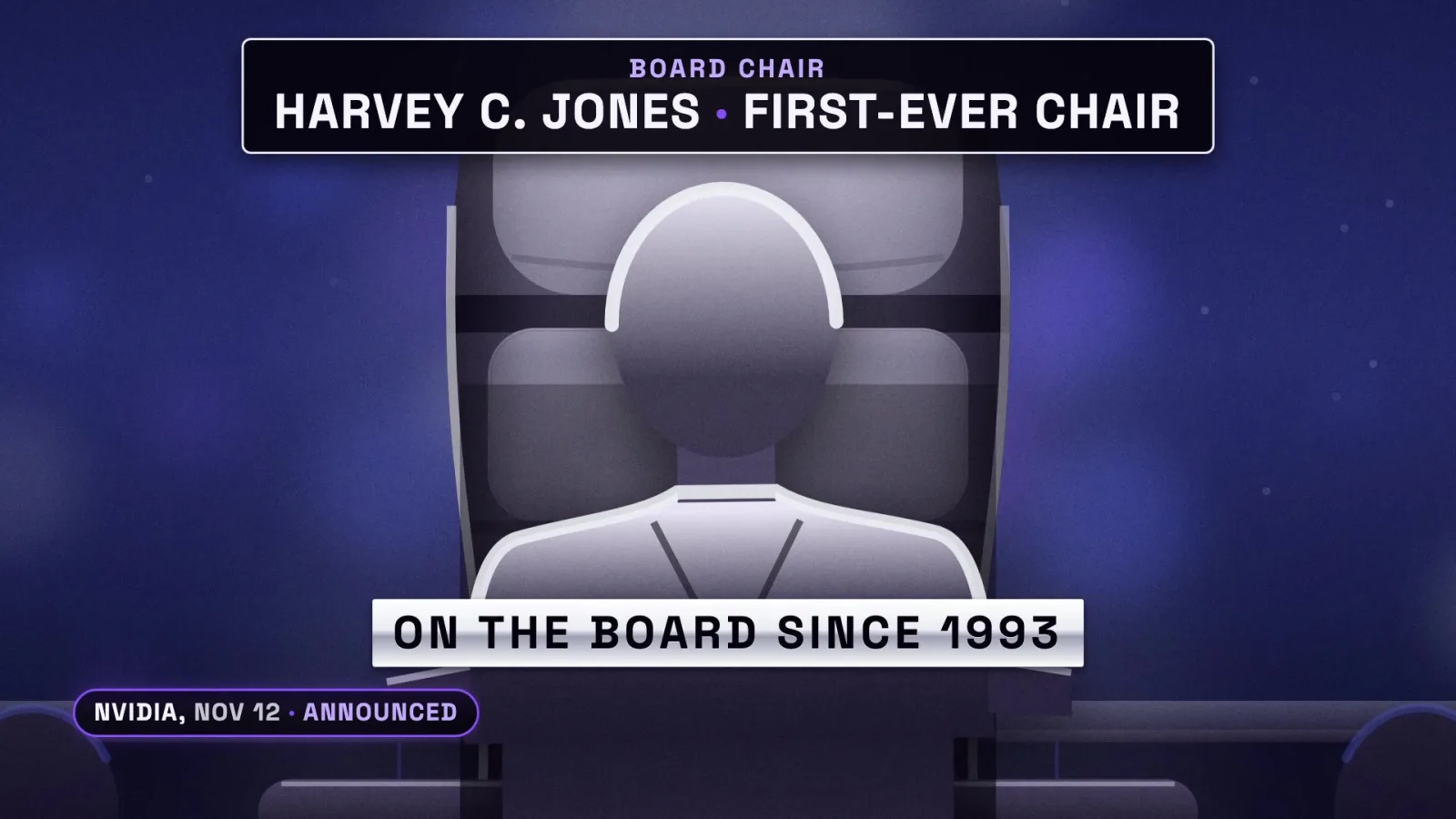
On November 11, Nvidia filled it with its "first-ever Chair of the Board": Harvey C. Jones, 73.
He's been on that board since 1993.
Sources
- Nvidia, Form 8-K (filed Nov 12, 2026)
- Nvidia, CEO transition press release, incl. the Nov 17 results date (Nov 12, 2026)
- CNBC, Huang's email and the board's statement (Nov 8, 2026)
- Reuters on The Information's report, via HuffPost (Nov 10, 2026)
- Gizmodo, Nvidia's reply to The Information (Nov 10, 2026)
- CNBC on the New York Times' memo report (Nov 8, 2026)
- AP via the Boston Globe, China's Foreign Ministry (Nov 9, 2026)
- Singapore Ministry of Home Affairs statement (Nov 12, 2026), as quoted by Mothership and CNBC
- U.S. Attorney General Todd Blanche, to reporters (Nov 12, 2026), via CNN
- Bloomberg, the lawyer's call and Nvidia's reply, via Yahoo Finance (Nov 9, 2026)
- Nvidia 2026 proxy statement (May 12, 2026)
- Nvidia 2019 proxy statement (Apr 12, 2019)
- Nvidia 2026 annual report (May 12, 2026)
- Cooley, on forming Nvidia in 1993 (Jun 30, 2021)
- Semafor (Nov 9, 2026)
- Lex Fridman Podcast #494, transcript (page dated Mar 23, 2026)
- CNBC live updates, Sonnenfeld (Nov 12, 2026)
- The Wall Street Journal's report, via TechCrunch (Nov 13, 2026)
- The Wall Street Journal's report, via To Vima (Nov 13, 2026)
- The New York Times on the briefing, via the Philadelphia Inquirer (Nov 10, 2026)
- The Register, the H200 deal (Dec 9, 2025)
- CNAS, how the H200 tariff works (Jan 16, 2026)
- TechCrunch, Kress named interim CEO (Nov 12, 2026)
- CNBC, the CEO search (Nov 13, 2026)
The Empty Chair is a sourced hot take from Tin Can Planet. Opinion and commentary; reported claims attributed, denials included; no one in this story charged as of Nov 13, 2026. The CEO, board and other figures are generic illustrations, not likenesses; Huang appears only in the credited photo. Figures as reported at the time; checked November 14, 2026.